
Push-Through Acrylic Signs: What They Are and Why Businesses Choose Them
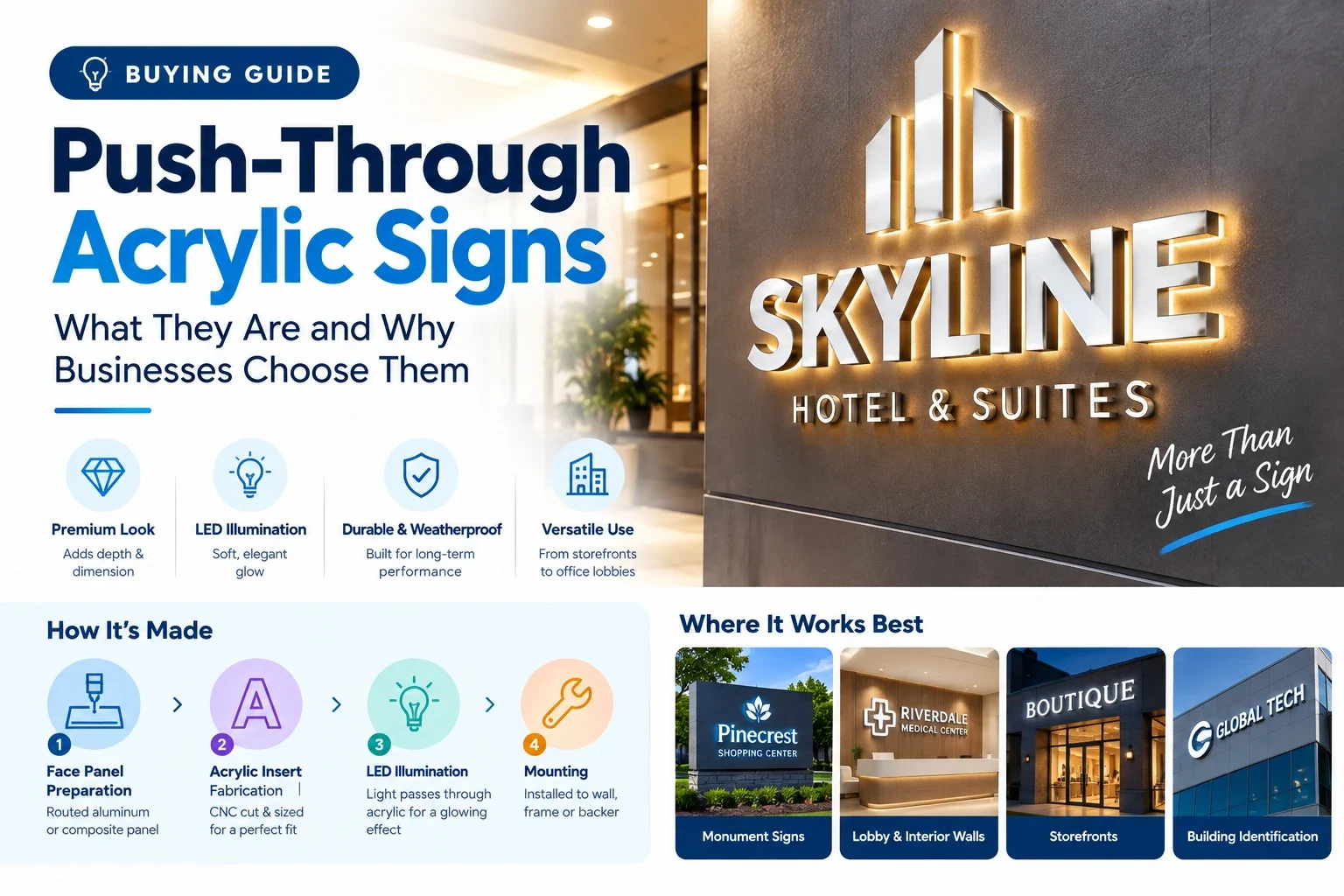
A design firm working on a boutique hotel lobby once ran into a wall, literally, trying to figure out how to make the property’s logo feel premium without looking like a typical illuminated cabinet sign. Flat backlit panels felt too generic for the space. Full channel letters felt like overkill for an interior wall. Somewhere in that search, the designer landed on push-through acrylic, and once the mockup came back, the decision was easy. The logo had depth, a soft glow at night, and a clean daytime look that read as genuinely upscale rather than just lit up.
That’s the appeal of push-through acrylic signs in a nutshell. They sit in a sweet spot between a basic flat sign and a full dimensional letter set, offering a layered, architectural look that a lot of businesses want but don’t always know how to ask for by name.
This guide covers exactly what push-through acrylic signage is, how it’s built, and where it tends to outperform other sign formats.
What Is a Push-Through Acrylic Sign?
At its simplest, a push-through acrylic sign consists of a solid metal or composite face panel with letters or logo elements route-cut out of it. Acrylic shapes—cut slightly larger than the cutouts—are pushed through from the back of the panel so that the acrylic face projects forward past the metal surface, typically by 3/16 inch to 1/2 inch.
When internal lighting (usually LEDs) is added behind the face panel, light travels through the acrylic elements only. The opaque metal face blocks light everywhere else. The result is a sharp, halo-lit or face-lit dimensional element that appears to float out from the sign face.
The key feature that sets push-through acrylic apart from standard cabinet signs is depth. Instead of a flat printed or vinyl graphic on a translucent sheet, the illuminated copy is physically dimensional.
How Push-Through Acrylic Signs Are Constructed
Understanding how these signs are made helps explain why they look the way they do—and why they require precise fabrication.
1. The Face Panel
The front panel is typically made from aluminum, aluminum composite material (ACM), or stainless steel. Aluminum is the most common choice because it is lightweight, rust-resistant, and easy to route cleanly. The panel is finished with paint, anodization, or a brushed metallic finish before any cutting happens. For technical details on substrate performance, consult material care guidance.
2. CNC Routing
A computer-controlled router cuts the text, logos, or graphic shapes directly into the metal face panel. The tolerances here must be tight—usually within a fraction of a millimeter—so the acrylic insert fits snugly without visible gaps or binding.
3. The Acrylic Inserts
The lettering or logo pieces are cut from clear or translucent white acrylic sheet using the same CNC file. The edge of each acrylic piece is often routed with a small lip or step (called a flange) on the back. This flange sits against the inside surface of the metal panel, keeping the letter from pushing all the way through while providing a flat surface for adhesive mounting.
4. Backing and Illumination
Behind the face panel sits a light-housing cabinet containing LED modules. White LEDs are standard, but RGB or color-changing LEDs can be used for specific branding needs. A translucent diffuser or colored vinyl overlay can be applied to the back or front of the acrylic to produce specific face colors when lit.
5. Assembly and Mounting
The acrylic pieces are secured to the face panel from behind using high-strength industrial adhesives or mechanical fasteners. The assembled face panel is then mounted to the cabinet, creating a sealed, weather-resistant enclosure. For high-elevation mounting, review standard ladder safety guidance before starting installation.
Key Benefits of Push-Through Acrylic Signage
Architectural, Upscale Appearance
Push-through acrylic signs have a refined, built-in look that works exceptionally well in modern corporate spaces, high-end retail, hospitality, and professional service environments. The combination of opaque metal and glowing acrylic creates a contrast that feels intentional and high-end.
Dual-Day and Night Visibility
During the day, the dimensional acrylic copy catches ambient light and creates subtle shadow lines against the metal face. At night, internal LEDs illuminate the acrylic elements, turning the sign into a high-contrast focal point.
Controlled Light Output
Unlike traditional light boxes that illuminate the entire sign face—often creating excess glare—push-through signs only allow light to pass through the specific letters or design elements. This controlled lighting makes the copy easier to read from a distance and reduces light bleed into surrounding areas.
High Durability and Weather Resistance
Because the LEDs and electrical components are completely enclosed within the cabinet and the acrylic elements are sealed into the metal face, push-through signs hold up exceptionally well to outdoor weather, UV exposure, and moisture. All structural materials are backed by the standard BASISSIGN warranty policy.
Versatile Finish Options
The metal face can be painted to match any PMS color, finished with a brushed or polished metal effect, or left as natural anodized aluminum. The acrylic inserts can be face-colored, edge-lit, back-lit, or paired with metallic vinyl faces for a day/night color-shift effect.
Common Applications for Push-Through Acrylic Signs
Push-through acrylic signage is widely used across both interior and exterior settings. Here are the most common environments where this format excels:
- Corporate Building Lobbies & Reception Walls: Creates an immediate impression of quality and permanence for visitors and clients.
- Boutique Retail & Luxury Storefronts: Offers a cleaner, more tailored look than standard channel letters or illuminated cabinets.
- Hotels, Resorts & Restaurants: Works well for both main entrance signage and interior directional or amenity sign packages.
- Financial Institutions & Professional Offices: Law firms, banks, and wealth management offices frequently choose push-through acrylic for its understated, professional aesthetic. Refer to our installation guidelines for wall structural requirements.
- Monuments & Pylon Signs: Push-through panels are commonly integrated into exterior monument structures at property entrances.
Push-Through Acrylic Signs vs. Other Sign Types
Comparing push-through acrylic to other popular illuminated sign formats helps clarify when it’s the right choice for your project.
| Sign Type | Key Characteristic | Typical Best Use | Relative Cost |
|---|---|---|---|
| Push-Through Acrylic | Dimensional acrylic pushed through metal face; flush or projecting copy | Lobbies, high-end retail, boutique storefronts, modern monuments | Moderate to High |
| Standard Light Box (Cabinet) | Flat translucent face with printed graphics; entire face glows | Budget commercial, strip malls, utility directional | Low to Moderate |
| Channel Letters | Individual 3D letters mounted directly to wall or raceway | Large exterior storefronts, building facades, shopping centers | Moderate to High |
| Halo-Lit (Reverse Channel) | Light projects backward against mounting surface to create soft halo | High-end interior/exterior walls, corporate identity | High |
Design Considerations Before Ordering
To get the best result from a push-through acrylic sign, keep these practical factors in mind during the planning phase:
Stroke Width and Detail Size
Extremely thin letter strokes or intricate graphic details can be difficult to route cleanly and may not provide enough surface area for proper acrylic insertion and adhesive bonding. A minimum stroke width of 3/8 inch (10 mm) is generally recommended.
Acrylic Thickness and Projection
Decide how far you want the acrylic to project past the metal face. A flush mount (0 projection) offers a sleek, flat appearance with glowing edges. A 1/2-inch projection creates a bold, highly dimensional effect.
Edge Finishing
The exposed edges of the push-through acrylic can be left smooth-matted, polished crystal clear, or frosted. Polished edges catch light dramatically, while frosted edges soften the illumination. For bespoke sign quotes, contact BASISSIGN directly.
Power Supply Placement
Ensure there is a suitable location for the LED transformers/drivers—either inside the cabinet, behind the wall, or in a remote power supply box—along with accessible service access for future maintenance.
Frequently Asked Questions About Push-Through Acrylic Signs
Can push-through acrylic signs be used outdoors?
Yes. When constructed with exterior-grade aluminum, UV-stable acrylic, and IP-rated LED modules, push-through acrylic signs are fully weather-resistant and suitable for outdoor installation on building facades, entry monuments, and pylon signs. Check out our custom push-through acrylic signs for exterior project examples.
What is the difference between push-through acrylic and channel letters?
Push-through acrylic signs use a single face panel with route-cut openings through which acrylic shapes project. Channel letters are individual, fully enclosed 3D letter structures mounted independently or on a raceway. Push-through signs offer a more integrated, cabinet-style footprint, while channel letters consist of separate individual elements. Compare with our illuminated channel letters or metal letters and logos to see which fits your storefront best.
Can push-through acrylic signs change colors?
Yes. By installing RGB or RGBW LED modules inside the cabinet, push-through signs can be programmed to change colors, pulse, or shift hues using a remote controller or smart lighting system.
How long do push-through acrylic signs last?
With quality aluminum fabrication, high-grade acrylic, and commercial LEDs, a push-through sign can last 7 to 10+ years with minimal maintenance. LEDs typically carry a lifespan rating of 50,000 hours or more. You can request a free mockup and quote to get exact manufacturing specifications for your project, or visit basissign.com to explore additional customization options.